Vertix® Systems. Engineered for life
Get A Price


Integrated Solar on Standing Seam Roofs: A Guide to EasySeam® Solar System
For many years, Solar PV on residential and light commercial buildings has followed a familiar pattern. The roof is installed first and then Solar PV panels arrive as a separate system, mounted on rails, clamped to seams, or fixed through the roof covering. These are fitted either before the scaffolding comes down and the building is signed off or at a later date as a retrofit.
That approach works, and in many cases it remains to be both a beneficial and appropriate option. But it also brings compromises: added weight, additional fixings, visual impact, and a sense that solar has been added on rather than designed in.
Integrated solar systems for standing seam roofs take a different approach. Instead of treating photovoltaics as a secondary installation, they make solar part of the roof itself. EasySeam® Solar System is one solution that combines a contemporary standing-seam roof with factory-bonded solar PV laminate to create a single, engineered roofing and energy system.
In this article, we’ll look at how integrated solar on standing seam roofs works in practice, and explore the technical considerations, benefits, and types of projects where this approach genuinely makes sense.
Rethinking Solar as Part of the Roof
The main idea behind integrated solar is simple: if a roof already occupies a large, sun-exposed area of a building, why not make that surface work harder?
With EasySeam Solar PV System, the Solar PV is not mounted above the roof. Instead, thin-film solar laminate is factory-bonded directly into the pan of the EasySeam standing seam roof panel. The seams remain untouched, the profile remains consistent, and the solar element becomes part of the roof itself.
The system is almost indistinguishable from a standard standing seam metal roof. There are no raised frames, no glass modules catching the light at odd angles, and no visible clamps or rails. For many homeowners and designers, that visual restraint is a significant part of the appeal.

How EasySeam Solar System Is Manufactured and Supplied
Many solar products that arrive on site as separate components from different manufacturers, but EasySeam Solar System is designed as a coordinated kit.
The process begins in the factory, where:
- EasySeam standing seam roof panels are manufactured to the required length
- High-efficiency Solar PV laminate modules are bonded to the EasySeam panels under controlled conditions
- Connectors are added, and each panel is electrically tested before leaving the manufacturing facility.
The Solar PV laminate Vertix Systems has chosen is manufactured by UK-based BIPVco and uses an industrial-grade adhesive specifically developed and tested for long-term performance and durability. Bonding the PV in controlled conditions ensures consistent adhesion, avoids site variability, and eliminates many of the durability concerns historically associated with early BIPV systems.
Panels are then delivered to the site as part of a kit of parts, including MC4 connectors to allow standard electrical connections once the roof is installed.
Solar PV Installation: What Happens on Site?
One of the most practical advantages of EasySeam Solar System is how it changes the sequence of work on site. The roof is installed by a professional roofing contractor in the normal way, using EasySeam panels. There is no separate solar mounting stage, no secondary fixings, and no need to return to the roof later to install rails or brackets.
Once the roofing work is complete:
- An MCS-certified or appropriately qualified electrical contractor connects the system
- The panels are strung using standard MC4 connectors supplied as part of EasySeam Solar System.
- The system is then tested and certified
A roofer will install the roof, and a qualified electrician will connect Solar PV systems. However, coordination is still essential. The roof layout, panel lengths, and solar string configuration will need to be pre agreed before manufacturing starts at the factory. This is not a system that can be trimmed to fit on site in the way that some standard roof panels can.
Weight, Structure, and Why It Matters More Than People Think
One of the most common challenges with mounted solar panels is weight. Framed glass PV modules, combined with rails, clamps, and fixings, add a surprising amount of load to a roof. On new builds, this can usually be accommodated at design stage.
On refurbishments, it often triggers structural assessments, strengthening works, or, in some cases, a complete rethink of the solar strategy. EasySeam Solar System has a fully installed weight of less than 11 kg per square metre. That figure includes both the roof panel and the Solar PV laminate.
This usually means:
- No additional structural strengthening required
- Reduced engineering complexity
- Greater suitability for refurbishment projects
- Less concern on lightweight or long-span roof structures
This low weight is one of the reasons integrated solar is increasingly specified on standing seam roofs, particularly where existing buildings are being upgraded to improve energy performance.
No Rails, No Penetrations and No Added Wind Load
Mounted solar installations rely on mechanical fixings. Even clamp-based systems on standing seam roofs introduce additional components, interfaces, and potential long-term risks. EasySeam Solar System eliminates these entirely, so there are:
- No rails
- No brackets
- No roof penetrations
- No elevated modules
Because the Solar PV laminate is bonded to the pan of the roof panel, there is no additional wind uplift and no need for separate wind load calculations for the PV system. The roof performs as a roof, and the solar performs as solar without one compromising the other.
This is especially valuable in exposed locations, coastal environments, or areas with high wind loading, where mounted panels can become a structural and insurance concern.

Integrated Solar PV Performance
Solar performance is often discussed in idealised terms, but UK conditions are rarely ideal. Cloud cover, low sun angles, and partial shading are part of our daily norm.
EasySeam Solar System uses a thin-film solar PV laminate technology, which behaves differently from conventional crystalline silicon panels.
Low-Light and Diffuse-Light Performance
Thin-film PV generates electricity from daylight, not heat. This means it continues to produce energy on overcast days, albeit at a reduced level. In the UK where diffuse light is common, this characteristic can be very valuable.
The system also uses a multiple bypass diode design, which helps maintain voltage and performance when:
- Parts of the roof are shaded
- Light levels are low
- The sun angle is less favourable
This makes EasySeam Solar System suitable for more than just south-facing roofs. East and also west facing elevations can still contribute meaningfully to overall energy generation.
Output, Efficiency, and Long-Term Guarantees
The solar PV laminate used in EasySeam Solar System has a cell efficiency of up to 24% and more importantly, it is backed by clear, long-term performance guarantees:
- 90% minimum output for the first 10 years
- 80% minimum output for the following 15 years
These guarantees matter because they reflect how the system is expected to perform over its real service life, not just at installation. Unlike some high-output panels that degrade rapidly, the focus here is on stable, predictable generation over 25 years or more.
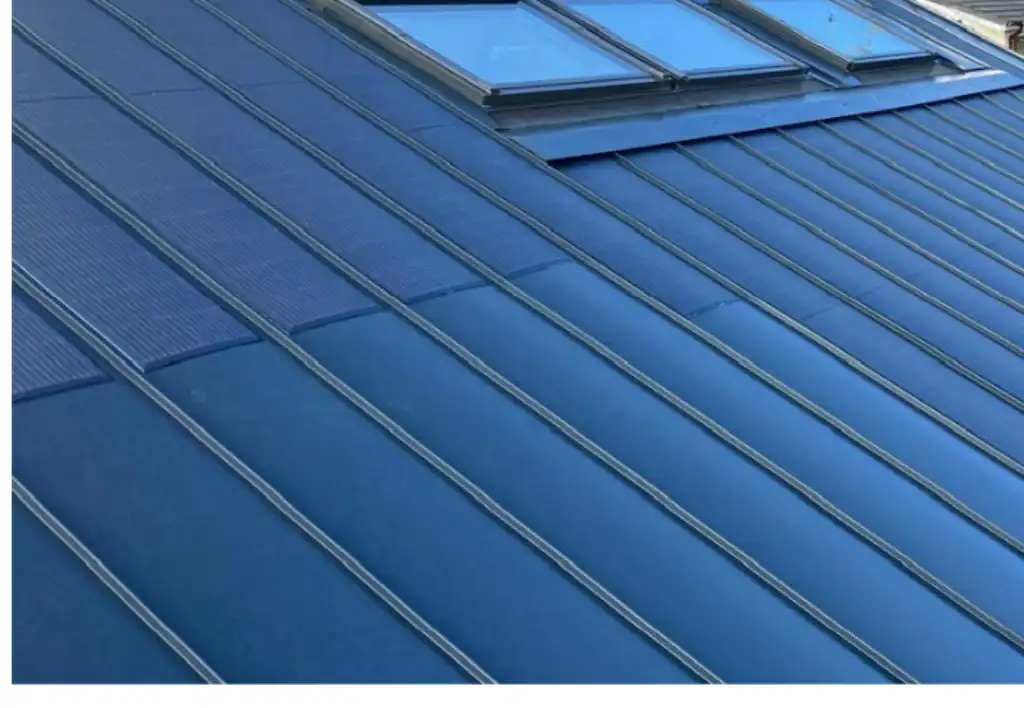
Integrated Solar Panels: Roof Pitch, Drainage, and Design Considerations
EasySeam Solar System is suitable for roof pitches between 5 and 45 degrees, which will cover the majority of residential and light commercial applications.
On a very low-pitched roof, extra care must be taken to ensure adequate drainage is in place and there’s no potential for ponding of water on the solar laminate itself. Yield may be slightly lower at shallow pitches, but this is often offset by the larger usable roof area available for PV coverage.
The building can use solar power without changing how it looks or what the architect originally designed. This is particularly relevant for:
- Contemporary homes
- Residential projects led by architects
- Buildings in visually sensitive locations
- Sites where planning constraints limit visible solar installations
In many cases, the system will fall under permitted development, though listed buildings and conservation areas may require approval.
Durability and Testing of EasySeam Solar System
Long-term durability is one of (if not the most important!) the biggest factors to consider for both roofing and solar systems. EasySeam Solar System has been designed and tested to meet demanding standards, with the solar PV laminate complying with:
- IEC 61215
- IEC 61730-1 and IEC 61730-2
- CE marking requirements
And has been thoroughly tested for:
- Adhesion and peel strength
- Thermal cycling
- UV exposure
- Humidity
- Impact resistance, including hail
The system is certified to operate between approximately -40° and 85°, making it very suitable for a wide range of environments.
Guarantees: Roofing and Solar, Covered Separately
One of the strengths of EasySeam Solar System is the clarity around warranties. The Solar PV laminate is covered by a 10-year product warranty and a 25-year performance warranty from BIPVco. The roofing material, made from Colorcoat Prisma® pre-finished steel, is covered by the 25-year Confidex® Home Guarantee from Tata Steel.
Confidex® Home Guarantee is provided directly to the homeowner, covers appearance and durability, and is fully transferable if the property is sold. This provides a level of reassurance that is often missing from more fragmented solar installations.
Integrated Solar PV Means Minimal Maintenance and Cleaning
Integrated Solar PV systems are sometimes thought to be harder to look after because they sit flush with the roof. But EasySeam Solar Systems are designed to be very low maintenance and require very little ongoing attention.
Most of the time, normal rainfall will do most of the cleaning. Rainwater naturally washes away dust, pollen, and everyday dirt that can build up on the surface, meaning there is rarely a need for manual cleaning. The solar panels are also finished with a smooth laminate top layer that significantly helps prevent dirt from sticking.
Routine maintenance is usually as simple as an occasional visual check. This can be done from ground level or during other roof inspections, just to make sure the system remains clear of debris and continues to look as expected. And, if cleaning is ever needed, it should be done gently. Using de-ionised water and a soft brush is recommended to avoid leaving mineral marks or causing surface wear.
High-pressure washers and standard tap water should be avoided, as they can damage both the solar laminate and the roof’s protective coating.
Solar PV Systems: End of Life, Recycling, and Sustainability
At the end of their life, the Solar PV laminate modules should be treated as electrical and electronic equipment and recycled through approved PV recycling streams under WEEE regulations.
Materials such as glass and metals can be easily recovered, supporting circular economy principles.
Integrated EasySeam Solar Systems can also contribute to sustainability assessments such as BREEAM or LEED by reducing operational carbon and regulated energy demand, subject to project-specific criteria.
Where Does Integrated Solar Make the Most Sense?
Integrated solar is a fantastic and modern solution, but it may not be intended to replace all mounted PV systems. It’s an option that’s well-suited to:
- New-build homes where solar is planned from the outset
- Roof refurbishments with limited structural capacity
- Projects where appearance and architectural integrity matter
- Low-pitch roofs where panels are less effective
- Homeowners seeking long-term reliability with minimal visual impact
For these scenarios, systems like EasySeam Solar System offer a practical, well-engineered alternative to traditional mounted solar.
A More Considered Approach to Solar
EasySeam Solar System does not try to be the loudest or most visually dominant solar solution. Instead, it focuses on integration, durability, and long-term performance.
By combining roof and solar into a single system, it simplifies installation, reduces risk, and delivers renewable energy in a way that feels intentional rather than added on.
For homeowners, designers, and contractors who value clean design, predictable performance, and long-term peace of mind, integrated solar on standing seam roofs represents a quiet but significant shift in how solar can be done.
If you’re interested in more information on our EasySeam® Solar System, get in touch with our team today.

Gordon is the Business Development Manager at Vertix Systems and a leading expert in pre-finished steel standing seam roofing. With over 18 years of experience, he helped develop Colorcoat Urban, the UK’s first residential standing seam system, and pioneered the industry-standard non-combustible wall solution.
Latest News

Take a look at the latest news from Vertix Systems

Vertix EasySeam® Roof System Achieves KIWA BDA Agrément Certification
Having completed a rigorous external assessment, Vertix EasySeam Roof System has been successful in securing KIWA BDA Agrément Certification.Read More
Vertix Systems Joins RIBA CPD Providers Network with Approved Moisture Management CPD
Vertix Systems has joined the RIBA CPD Providers Network and secured RIBA approval for its first Continuing Professional Development (CPD) seminar, Using Roof Build-ups to Manage Moisture in Low U-Value Buildings and provide a healthier environment for occupants.Moisture management remains one of the most significant factors affecting the long-term performance, durability and safety of buildings. When moisture is not effectively controlled, the consequences can be extensive, ranging from deterioration of the building fabric and reduced asset value to increased maintenance costs and potential health and safety risks for occupants.Read More- Gordon Crichton
Integrated Solar on Standing Seam Roofs: A Guide to EasySeam® Solar System
In this article, we look at how integrated solar on standing seam roofs works in practice, and explore the technical considerations, benefits, and types of projects where this approach genuinely makes sense.Read More  Gordon Crichton
A Guide to Mounted Solar Panels on Standing Seam Roofs
In this article, we’ll cover mounted solar PV systems on standing-seam roofs and explain how they work, how they are installed, the technical factors that matter most, and where this approach is best suited.Read More
Visit Us at the National Homebuilding & Renovating Show NEC 2026
We’re delighted to announce that we’ll be exhibiting at the National Homebuilding & Renovating Show at NEC Birmingham from 19–22 March 2026. The show is a major event for self-builders, renovators, and construction professionals, and we’re excited to be part of it once again.Read More
We’re exhibiting at Homebuilding & Renovating Show Farnborough 2026
We’re excited to be exhibiting at the Homebuilding & Renovating Show in Farnborough on 17-18 January 2026 for the first time. This event is a key date in the calendar for self-builders, renovators and construction professionals and we’re looking forward to showcasing our innovative metal standing seam systems.Read More
